

2026 High-End Hotel Carpet Design Trends: The Integration of Minimalism and Natural Texture
Last month, I attended a hotel design forum in Shenzhen. On stage, a well-known designer showed a photo of a hotel lobby from 2020 and asked the audience: ”Five years ago you thought this design was very upscale; what about now?” The hall fell silent for a few seconds. He said: ”It’s not that it looks bad now; it’s that your aesthetic standards have changed.”
The design language of hotel carpets goes through a cycle of iteration every 3-4 years. The elaborate damask patterns, highly saturated contrasting colors, and dense geometric motifs that were popular in the past few years are rapidly fading out, replaced by two keywords:Minimalism and natural texture. This is not the personal preference of a few designers; we can clearly see this trend taking shape in the project demand changes we received in 2024-2025.
1. Minimalism is not ”simple”; it is ”doing subtraction right”
Many clients hear ”minimalism” and immediately think, ”Then just lay down a solid-color carpet.” If only it were that simple.Minimalist-style carpets are actually the hardest to get right—because there are no complex patterns to hide craftsmanship flaws, so yarn quality, dyeing consistency, pile flatness, and seam precision are all exposed.
Several specific characteristics of the minimalist trend in 2026:
| Trend characteristics | Specific manifestations | Implementation challenges |
|---|---|---|
| Low-saturation color palette | Off-white, oat, gray-brown, and sand colors replace deep blue and burgundy | Color difference tolerance is extremely low; within a single batch, ΔE must be controlled to ≤1.5 |
| Monochrome gradient | Subtle transitions from light to dark within the same color family | Gun-tufting requires high density (50-60 stitches/sq ft) to achieve a smooth gradient |
| Large areas of negative space | Patterns compressed into local areas or edges | Extremely high requirements for seamless splicing; roll width needs to exceed 4 meters |
| Subtractive composition | Borders removed, symmetrical central motifs removed | The sense of space is supported entirely by the material itself |
Last week, I went to see an Andaz project that opened this July in East China. From a distance, the lobby carpet looked like a simple light sand color, but when I got closer I noticed a very subtle wave-like texture on the pile — made byalternating weaving with two yarns of the same color but different twist levelsAnd you can only see the shimmering light-and-shadow effect from the side. The designer said this is a ”pattern that exists only under light.” Honestly, this kind of minimalism is ten times harder than drawing a flower.
2. Natural texture: the material itself becomes the design language
If minimalism is ”what to remove,” then natural texture is ”what to use to replace what was removed.” The answer is clear:Speak with the material itself.
The hottest natural texture directions in 2026:
1. Stone-grain / rock-grain texture
It’s not printed on; it simulates the natural graininess of granite and limestone through yarn color blending + pile-height variation. The most effective solution our team has tested isThree-color blended yarn + random tufting depth—Using different pile heights in the same area creates a layered, three-dimensional effect. From a distance, it looks like the crystalline grains of natural stone. This is not pattern design; it is process design.
2. Woven feel / textile texture
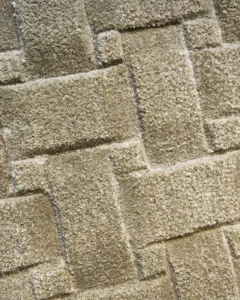
Simulating the warp-and-weft interlacing effect of linen, tweed, and bamboo weave. This direction is especially suitable for handwoven carpets. Last year, a Ritz-Carlton project in Nanjing used a custom carpet with a ”linen-woven” leather-like finish in the guestroom area—it looked like a magnified piece of linen laid on the floor, yet the touch was a soft velour surface. This fun sense of ”visual dislocation” is a technique designers are especially fond of right now.
3. Water ripple / sand ripple / wood grain
Flowing curved patterns are making a comeback, but not the literal wave patterns of the past; instead,highly abstract, pixelated gradient textures—From a distance, it looks like ink wash spreading; up close, you can see yarns arranged in a gradient from light to dark. This effect is easiest to achieve with tufting, using continuous dyeing (space dyeing) technology, where a single yarn carries a three-color transition.
💡 Tip: For custom carpets with natural textures, you must check thelarge-scale actual product. It may look beautiful on a 30 cm sample, but once it covers 100 square meters, the visual effect may become ”blurry.” Our experience is that the sample should be at least1 m × 1 mto judge whether the visual density of the texture is appropriate.
III. The driving forces behind the trend: aesthetic evolution and operational logic
Why 2026, specifically?
From an aesthetic perspective, over the past decade hotel interior design has evolved from ”European retro → decorative style → modern eclecticism.” Boutique hotels opening in clusters in 2024–2025 (such as Janu, a new brand under Aman; Thompson Hotels under Hyatt; and InterContinental’s Vignette Collection) have collectively shifted toward a ”quiet luxury” direction. As the largest soft furnishing element in terms of floor area, carpets naturally need to align with this language.
From an operational perspective, carpets with complex patterns are extremely costly to maintain—when cleaning is insufficient, stains are amplified within the pattern, and the overall visual aging happens far faster than with solid-color carpets. Data from a resort hotel in Sanya shows that the average replacement cycle for patterned carpets is4.2 yearswhile solid-color / low-pattern carpets in the same area can last6.8 years. Those extra 2.6 years of lifespan translate into capital expenditure savings in the tens of millions for hotel chains.
STR Global’s “Asia-Pacific Premium Hotel CapEx Trends Report” released in Q4 2025 also confirms this point:73% of surveyed hotel groups are incorporating ”low-maintenance design” into their soft furnishing procurement standards. The combination of minimalism + natural texture hits this point perfectly—visually premium, and easy to maintain.
4. When Trends Hit Projects: Several Real-World Questions
Question 1: Minimalism Does Not Mean Cheap
This is the biggest misconception. A high-quality minimalist solid-color rug requires far higher standards for yarn grade, dyeing precision, and pile flatness than a patterned rug of the same area. For guestroom rugs of the same size, the procurement cost of a solid-color solution may be higher than that of a patterned solution15%-20%because the defect rate is higher—flaws that can be hidden by patterns are fully exposed on solid colors.
Question 2: Natural Texture Depends Heavily on Production Techniques
Not every factory can do it. Stone-like textures require three-color blending and varying-depth tufting techniques; woven textures require specific yarn-twisting processes; water-ripple gradients require continuous dyeing capabilities. When working with designers, we often have to help them ”translate design effects into process language” — for example, if a designer wants ”the texture of wind sweeping over sand dunes,” our technicians need to break it down into: how many colors to blend, how many millimeters of pile-height difference, what stitch density to set, and what type of backing to choose.
Question 3: Texture Density Must Be Adjusted for Small and Large Spaces
The same texture design will look completely different in a 20㎡ guest room and an 800㎡ banquet hall. Texture density needs to be reduced in small spaces, otherwise it will look too ”full”; in large spaces, texture density needs to be increased, otherwise it will just look like a solid-color surface from a distance. Designers usually do not distinguish this when providing drawings, so factory technicians need to make secondary adjustments based on the actual space dimensions.
5. What We Will Do in the Next Two Years
Since early 2024, the design and R&D team at Yisen Carpet has been building a material library around ”digitalized natural textures.” We have now completed process implementation solutions for **12 basic texture categories (stone texture, water ripple, wood grain, sand grain, woven texture, moss texture, rock layering, bark texture, feather texture, paper fiber texture, concrete texture, metal oxidation texture)**. Each category has 3–5 variants that can be customized according to the project’s color palette and spatial dimensions.
Another direction we are exploring is breaking the ”flat” nature of carpets, so that differences in pile height, changes in yarn thickness, and variations in weaving density themselves become the design language, rather than patterns printed on top.Let the carpet shift from a ”painted carpet” back to a ”woven carpet,” This is our judgment of the trend for 2026-2028.
Back to the question at the beginning
That designer said the aesthetic standards have changed. My understanding is: the market is shifting from ”looking luxurious” to ”feeling comfortable to live in.” Minimalism and natural textures happen to be the ground-level expression of this shift—carpets are no longer the ”decorative item” of a space, but the space’s ”base tone.”
If you are planning a hotel project opening around 2026, here are a few suggestions for carpet design:
- Determine the design direction early; minimalist/natural-texture routes require a longer sampling cycle
- Leave enough time for color confirmation; minimalist styles are far more sensitive to color than patterned solutions
- Include process costs and upfront R&D investment in the budget; minimalist does not mean cost-saving
- Be sure to review large-area physical samples; computer renderings have limited reference value for natural-texture designs
In the projects our team has worked on over the past few years, the question designers ask most often is: ”How far can you go?” Our answer is: ”Send us the texture you want, and we’ll first evaluate the process feasibility.” From a single yarn to a full surface of texture, every step in between can be discussed in detail. If you need a specific trend case study set or process reference samples, Yisen Carpet’s design team is always available for in-depth discussions.
Related Articles
Carpet Care and Maintenance Guide: Secrets to Extending the Lifespan of Hotel Carpets
July 9, 2026
Last month, during a return visit to a Courtyard project in North China, the engineering director pointed at a piece of flooring in the lobby
B1 Flame Retardant Standard: An Analysis of Hotel Carpet Safety Performance
July 9, 2026
Last year, at a project in Chengdu, the client suddenly informed procurement that the fire inspection had to
How can custom carpets perfectly blend with interior design styles?
July 9, 2026
At a high-end boutique hotel project in Guangzhou last year, the designer chose a very outstand-
Wool vs. nylon: An in-depth comparison of high-end hotel carpet materials
July 9, 2026
Last year, while helping a Marriott project in Beijing with material selection, the client representative came right out and said